| |
|
 |
| |
|
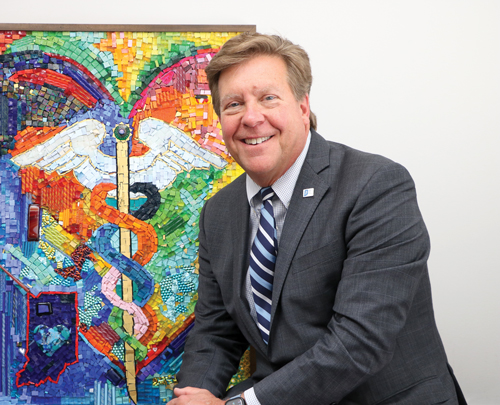
Clif Knight, MD, CPE, FAAFP
|
By Richard Gunderman, MD, PhD
Effective July 20, 2026, Clif Knight, MD, became the new Executive Vice President of the ISMA. A graduate of Ball State University, he attended medical school at Indiana University and then completed family medicine residency at Community East Hospital in Indianapolis. He is a Certified Physician Executive and a Fellow of the American Academy of Family Physicians.
After practicing rural medicine in Indiana, Dr. Knight assumed the role of Director of the Family Medicine Residency Program at Community Health Network, where he later served as Chief Medical Officer. He then served as Senior Vice President of Education at the AAFP before returning to Indianapolis as Assistant Dean at the Marian University Wood College of Osteopathic Medicine.
In thinking about his new role at ISMA, Dr. Knight emphasizes the importance of advocating effectively for the physicians of Indiana. By advocacy, he means not only government legislation and policy but working with hospitals, employers, insurers, and the many other stakeholders in health care in our state.
At the core of the mission, however, are the state’s 18,600 actively practicing physicians. “If we can help our colleagues do a better job of caring for patients and improve health outcomes in our state, we will have done our job. Of course, we cannot do everything, and we need to establish clear priorities.”
One such priority he points to is education. “We need to think of medical education as a continuum stretching from interest among young people in our profession and premedical studies all the way through medical school, residency, fellowship, continuing medical education, and even programming for part-time and retired physicians.”
Another such priority is the well-being of physicians, including our ability to thrive in practice.
“Education plays a crucial role here, as all of us must keep learning and adapting, but so too must programming focused on physician wellness, such as ISMA’s annual Physician Wellness Symposium, which addresses both the individual and systemic factors,” he said.
In an article he and a colleague co-authored in Family Practice Management in 2019, he describes what might be called the medical ecosystem, which consists of the health care system broadly, individual health care organizations, the medical practice, the individual physician, and the physician culture. “We need to take each of these components into account to make the physician work environment and medicine better.”
In addressing his priorities, Dr. Knight emphasizes the diversity of physician fields, practice types, and sources of motivation.
“As CMO, I learned that physicians vary in terms of what makes us tick, and we need to make sure that we are understanding one another so we can structure medical practices and ISMA programming accordingly,” he said. “Some physicians are very community focused and care a lot about broad-based advocacy for public health, while others are largely focused on providing the best care possible to the patient in front of them at the moment. This diversity is a strength for our profession, and we need to weave together different colleagues’ interests and aptitudes.”
Dr. Knight continues: “In emergency medicine, the priority is to get the patient stabilized and patched up. Continuity is not such a high priority as it might be for a primary care physician. Likewise, a proceduralist may be most invested in ensuring that their particular procedure goes as well as possible. Each is different, yet each plays a vital role.”
He sees much of this diversity in his own practice history. “When I was in rural practice, some things mattered more, but when I became residency director, other priorities assumed more importance, and this happened again when I became CMO, vice president for a specialty society, and then an assistant dean. To serve our colleague well, we must first understand them.”
Dr. Knight is excited about the teambuilding he plans to accomplish at ISMA.
“My fulfillment is in building teams and seeing members go on to develop both professionally and personally and make their distinctive contributions to the profession.”
He looks forward to helping ISMA’s elected leaders make such differences. He is also particularly interested in supporting leadership development in Indiana’s medical students, residents, fellows, and early career physicians. He also believes it is important to keep things in perspective.
“As a leader, I’ve been asked how I stay calm during tense moments. In the practice of medicine, there are true tragedies, but there are really very few administrative tragedies.”
One of the greatest sources of gratification for Dr. Knight has been running into medical students and residents he helped to train over the past 30 to 40 years. Some of them still recite things he taught them or bits of advice he shared, expressing gratitude. “We need to remember that we are leading not just for today, but for generations of physicians to come. A relatively minor-appearing act may be much more impactful than we recognize in the moment.”
“The key is for physicians to recognize how much stronger we are together than when we are fragmented,” he said. “We need to make time to talk with one another and ensure that different voices are heard, but we must also come together and help the house of medicine speak with a strong, unified voice on behalf of our patients and communities.”