New guidelines for clinicians who treat outpatients suffering from acute pain are the latest contribution by ISMA and other health care leaders to the fight against opioid addiction in Indiana.
The Indiana Prescribing Guidelines for the Management of Acute Pain, announced Jan. 17, provide suggestions for the safe, appropriate and effective prescribing of self-administered medications for pain, with an emphasis on alternatives to opioids. The guidelines recognize that each patient’s needs are unique and defer to the clinical judgment of prescribers.
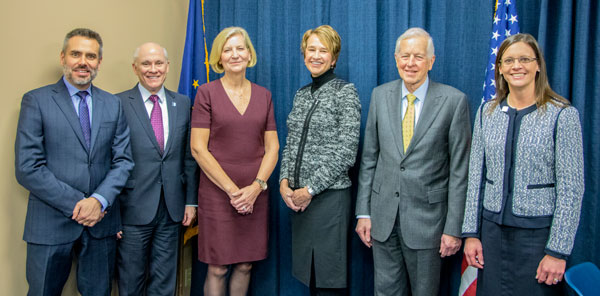 |
| (From left) IHA President Brian Tabor; ISMA President John P. McGoff, MD; ISDH Commissioner Kris Box, MD; Dearborn Hospital CMO Nancy Kennedy, MD; Indiana Commission to Combat Drug Abuse Chair Jim McClelland; ISMA Executive Vice President Julie Reed, JD. |
Introduced at a news conference by officials from ISMA, the Indiana Hospital Association (IHA) and the Indiana State Department of Health (ISDH), the acute pain guidelines complement a similar opioid prescribing protocol for emergency physicians and the 2014 Indiana Chronic Pain Management Prescribing Rule.
The new guidelines outline a process that includes key checkpoints at which clinicians can pause to consider additional factors, said Kris Box, MD, Indiana’s state health commissioner. They allow a physician to assess the patient, make a diagnosis and develop a plan that addresses the patient’s acute pain while considering all treatment options. It also includes re-evaluating to determine the effectiveness of the treatment plan, she said.
“Not a day goes by that I don’t treat an overdose from an opiate,” said ISMA President John P. McGoff, MD, an emergency physician. “Doctors, pharmacists and the state are all working together to fight Indiana’s opioid crisis, and today’s announcement … is just another step in the right direction.”
ISMA Executive Vice President Julie Reed, JD, also noted that ongoing collaboration is key to curbing opioid addiction and overdose deaths in Indiana. “We all know that the opioid crisis is negatively impacting families, that it is negatively impacting our communities and our workforce,” she said. “We as organizations are all committed to addressing that and coming to solutions together.”
The complete text of the new guidelines and other state opioid prescribing documents are available to read on ISMA’s website:
Indiana Prescribing Guidelines for the Management of Acute Pain
Indiana Guidelines for Opioid Prescribing in the Emergency Department
Indiana Chronic Pain Management Prescribing Rule